
From Personal to Business: Why Your Organization Needs a Knowledge Operating System
Your team's knowledge is scattered across emails, meetings, project tools, and people's heads. What if there was a system that didn't just store it all – but actually connected it?

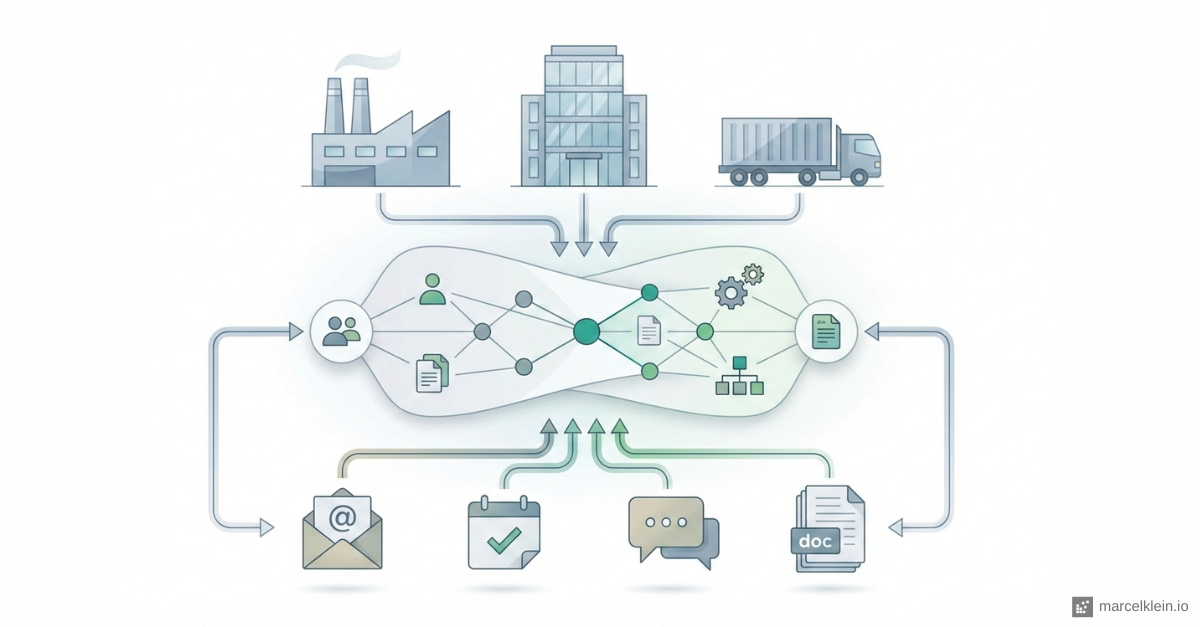
In my last article, I introduced the idea of a Personal Knowledge Operating System – a system that connects your emails, meetings, documents, and notes into actual knowledge instead of scattered files. The core idea was simple: stop spending time searching for information and start having it available when you need it.
But here's the thing. The same problem doesn't stop at the individual level. It gets worse when you zoom out to the business.
The same pain, amplified
As a knowledge worker, your personal information is already fragmented. Now multiply that by every person on your team. By every department. By every project running in parallel. The amount of disconnected knowledge in a business is staggering – and it's costing real time and real money.
Think about something as fundamental as your business contacts. It starts with a simple address book where you keep your professional relationships. Maybe a CRM system that already captures more: which role does this person have, which company, what was the last interaction, what's their decision-making authority. That's useful. But it's still just a snapshot.
What's missing is the living context around that person. What projects are we working on together right now? What topics are still open? Is there something they're waiting on from me? What tasks did we agree on in our last call? What's the status of the proposal I sent them three weeks ago?
That information exists – spread across emails, meeting notes, calendar entries, chat messages, and maybe a task in Asana that hasn't been updated in a while. But nobody stitches it together. You do that manually, every single time, before every meeting.
What a Business Knowledge Operating System looks like
In the personal version, I described three layers: input channels, a knowledge graph, and smart outputs. The business version follows the same architecture. But the entities and relationships grow significantly.
The inputs expand. Beyond personal emails and calendar entries, you now have meeting summaries with decisions and action items. Shared documents and contracts. Voice memos and notes that people create to organize their thoughts on a project. Incident reports from IT helpdesk systems. Asset inventories. Project plans with milestones and dependencies.
The entities multiply. In a Personal Knowledge Operating System, the core entities are people, companies, dates, and documents. In a business context, you add projects with their plans and task lists. You add assets, both physical and digital. You add incidents and support tickets. You add budgets and financial commitments. Every one of these entities has relationships to the others, and those relationships change over time.
The outputs get more powerful. Instead of just "here's what you need to know before your meeting," the system can now tell you: "Project Alpha is behind schedule because three tasks are blocked. Two of those blocks trace back to an open decision from the steering committee two weeks ago. Here's the relevant excerpt from the meeting notes."
That's the shift from a personal tool to a business operating system for knowledge.
The meeting problem nobody talks about
Here's an honest question: if your workday is filled with back-to-back meetings, how many of those meetings do you actually capture properly? And I mean really capture – not just "I was there," but notes, decisions, action items, things that feed into your personal to-do list.
Some people are disciplined about it. Most aren't. And even if your organization uses automatic transcriptions in Teams or Zoom, how often do you go back, review the transcript, and extract the right conclusions and next steps from it? In my experience, rarely. The transcription exists, but it sits there untouched. The meeting happened, the information was shared, and then it evaporates. The decisions were made, but three weeks later nobody remembers the details.
Now multiply that by five meetings a day. That's an enormous amount of professional knowledge that simply gets lost because there's no system to automatically extract and connect the relevant pieces.
The project plan nobody keeps up to date
Let's be honest about something. We all know the theory: keep your Asana or Jira board updated, move tickets through the pipeline, write proper status notes. And we all know the reality: most people don't do it consistently. Not because they're lazy, but because updating a project management tool feels like overhead when you're busy actually doing the work.
A Business Knowledge Operating System changes that dynamic. If the system already processes meeting transcriptions, summaries, emails, and task discussions, it can extract status updates automatically. The meeting you didn't take notes in? The system did. The action item that someone mentioned in passing? Captured, connected to the right project, assigned to the right person. Not just a checkbox that says "in progress," but an actual history of what happened, what was discussed, when things changed, and why.
That's a level of project documentation that most organizations dream about but never achieve. Because it doesn't depend on anyone's discipline to manually fill in fields. The information is already there in the communication. It just needs to be connected.
Public, private, and shared – the access question
Here's where the business context introduces a challenge that doesn't exist in the personal version: who gets to see what?
Some information is naturally public within an organization. General project updates, company announcements, shared documentation. Other information is private – my personal notes, my voice memos, my draft thoughts on a topic that isn't ready for broader discussion.
It gets interesting when teams overlap. If three people from my team all interact with the same client, there's huge value in having shared context. Not just "I had a meeting with them last Tuesday," but the full picture: communication history, open items, agreed-upon next steps. Knowledge that lives with the team, not just with individuals.
You've probably been in this situation: you're in a meeting, a topic comes up, and someone says "Ah yes, I already discussed that with Sarah last week and we agreed to go with option B." Great. But nobody else knew about that conversation. The decision was made, the alignment happened, but the information never reached the people who needed it. No notification, no update, no trace in any shared system. It only surfaced because someone happened to mention it.
That's not a communication failure on anyone's part. It's a systems failure. A Business Knowledge Operating System that understands entities and relationships would recognize that a decision relevant to your project was made in a conversation you weren't part of, and surface it to you. Not by drowning you in notifications, but by connecting it to the right context: "Before your meeting tomorrow, here's something relevant that was discussed between Sarah and Thomas last Thursday."
Of course, this only works if the system is actually connected to the source. For virtual meetings, that means access to transcripts. Most organizations already generate these through Teams or Zoom. The gap is in-person meetings, where no automatic transcript exists unless someone deliberately captures it. Interestingly, I see more and more people bridging this by running Teams in the background during in-person meetings purely to capture the audio. It's a pragmatic workaround, but it shows how valuable people consider the transcript data to be, even if they rarely review it manually today.
The ideal scenario for an organization would be radical transparency – all information accessible to everyone. More shared knowledge means better decisions, fewer duplicated efforts, less time spent asking colleagues for context they already have. That's the principle behind breaking down silos, and it's not a new idea.
But I'm realistic. Financial data, HR topics, sensitive negotiations – not everything can be open to everyone. The point isn't to force full transparency. The point is to default to sharing and only restrict where genuinely necessary. That's a mindset shift many organizations still need to make.
From knowledge silos to connected intelligence
The bigger picture here is about something I see across industries, including in Operational Technology where I work day to day. Whether it's a knowledge worker preparing for a client meeting or a maintenance team approaching a piece of equipment – the core problem is the same. Relevant information exists, but it's scattered across systems, documents, and people's heads.
In IT, think about what happens when something breaks. The helpdesk ticket captures the symptom. The incident management system tracks the response. The asset database tells you what hardware is affected. The change log shows what was modified recently. The knowledge base might have a similar issue documented. Each of these systems has a piece of the puzzle. But the engineer troubleshooting at 2 AM has to pull it all together manually.
A Business Knowledge Operating System would surface that connected picture automatically. Not as a replacement for these specialized tools, but as a layer on top that understands the relationships between entities across all of them.
The physics of the problem
There's a thinking framework often attributed to Elon Musk that I find useful here: ask yourself "What are the physics of this problem?" Strip away assumptions and look at the fundamental structure.
For the company I currently work for, which produces automotive parts, the physics look roughly like this. You have factories with physical assets and production lines. You have logistics connecting those factories to suppliers and customers. You have local departments running operations on the ground: maintenance, quality, production. And you have a corporate layer with its own departments: finance, HR, IT, strategy. All of these layers exist for one purpose: to execute processes. Manufacturing processes, quality processes, procurement processes, HR processes. Processes are the operating logic of the business.
Now here's the key question: where does the knowledge graph sit in this picture?
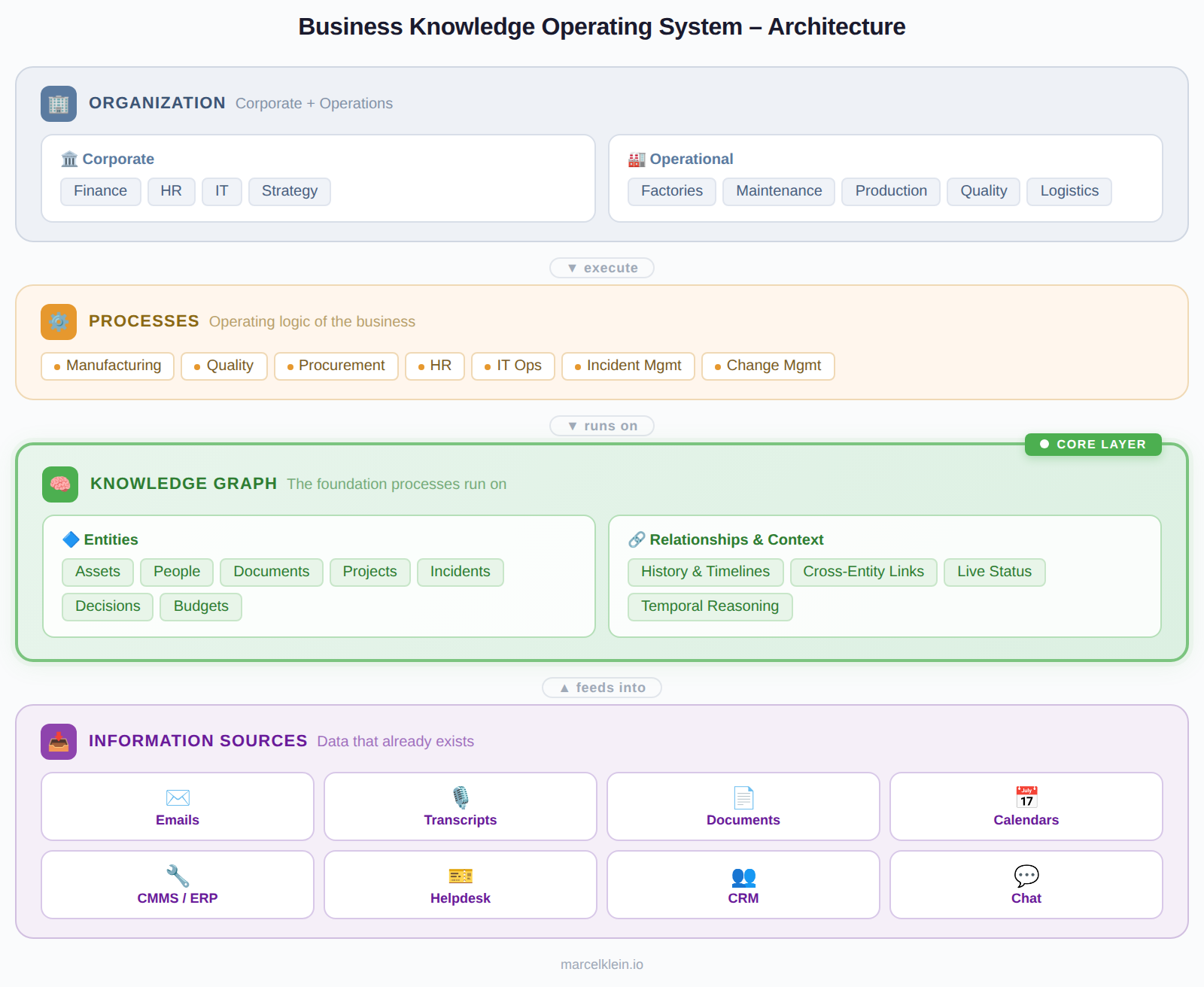
Right below the processes. The knowledge graph is the foundation that processes run on. It contains the entities (assets, people, documents, incidents, decisions) and their relationships across all layers of the organization. When a maintenance process requires information about a specific machine, the knowledge graph knows the asset's history, its open incidents, the last inspection report, the spare parts on order, and the contact person at the supplier. When a quality process flags a deviation, the knowledge graph connects it to the production batch, the raw material supplier, and the relevant specification document.
Without that connected knowledge layer, every process has to gather its own context from scratch. People pull information from five different systems, call three colleagues, and still aren't sure they have the full picture. The process itself might be well-designed, but it runs on incomplete information.
That's the physics of the problem. And it applies whether you're running a factory or managing a consulting practice.
This is where it's heading
If the Personal Knowledge Operating System is about making you more effective as an individual, the business version is about making the entire organization smarter. Less time gathering context, more time acting on it. Less reliance on individual memory and discipline for documentation, more automatic knowledge capture from the work that's already happening.
The technology to build this exists today. Entity extraction, knowledge graphs, temporal reasoning, natural language processing – these aren't future concepts anymore. The question is how to connect them in a way that integrates with existing workflows instead of adding yet another tool to the stack.
That's the direction I'm exploring – both in my thinking about how organizations handle knowledge and in what I'm building with Paperarchive. Starting with documents, expanding to connected entities, and working toward a system that doesn't just store information but actually understands it.
Because the goal hasn't changed since the first article. It's still the same: stop searching, start knowing. Just at a bigger scale.
Enjoyed the post or have feedback? I'd love to hear from you. Just reply via email, or connect on LinkedIn. Feel free to share this post on X, LinkedIn, or Facebook if you think someone else might enjoy it too.