
AI as a Trojan Horse
Most companies want AI. Most companies are not ready for it. Not because AI is too complex – but because the foundation it requires was never finished.

How the Hype Is Finally Forcing the Homework
Right now, the same conversation is happening in almost every company. Somewhere around the leadership table, someone says: "We need to do something with AI, or we'll run behind the bus entirely." The sentence lands, the energy is there, the hunt for budget begins.
The problem: most companies are not ready for it.
Not because AI is too complex. But because the foundation is missing – the one AI needs to function.
The Pyramid Nobody Wants to Hear About
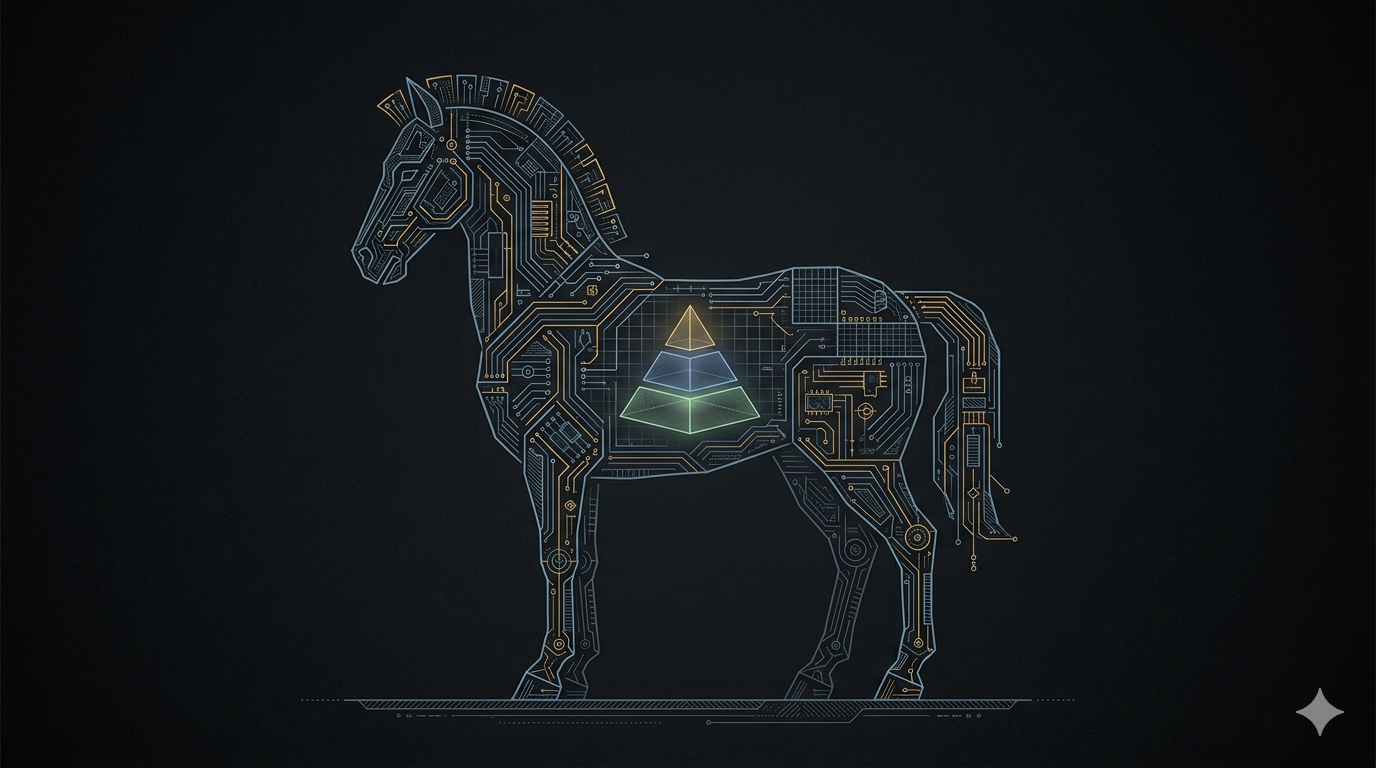
AI is not a standalone technology you simply layer on top of what exists. It is the tip of a pyramid – and it stands or falls with what lies beneath it.
The three layers:
Digital processes form the foundation. The company's value chain must be digitally mapped. Where Excel workarounds, manual handoffs, and shadow IT still dominate, there is nothing for AI to work with.
Data management is the middle layer. Data must be structured, accessible, and reliable. Not just anywhere. Systematically. Governance included.
AI is the tip. This is where leverage is created: the ability to recognize patterns across large datasets, support decisions, and automate processes.
Without the lower layers, the tip is worthless. That is not an opinion – it is architecture.
An example playing out in many companies right now: Microsoft Copilot is being rolled out across administration. That is not wrong – Copilot can reveal potential and ease workloads. But using Copilot inside Excel files does not solve the underlying problem. The missing digital processes are still not digital. The data layer is still unstructured. The pyramid has a new tip – the foundation is still crumbling.
Placing AI tools on top of existing structures is not digitization progress. It is treating symptoms.
Why This Homework Has Been Left Undone
Digitization initiatives, process management programs, and data management efforts have shared a similar fate in many companies over recent years: launched, stalled, kept on life support.
With process management, there is a particular irony. Many companies are ISO-certified – their processes formally described, reviewed, and approved. But described processes and lived processes are often two entirely different realities. The documentation sits in the QMS, while work carries on alongside it. What has been digitally mapped is the target state – not the actual state. No AI can be built on that gap.
The reasons for stalling are familiar. The topic is complex and slow-moving. Results are hard to measure. And the ROI question is difficult to answer convincingly as long as the concrete benefit remains abstract.
No one on the executive team walks into the office in the morning wanting a better data governance framework. Digital processes sound like an IT project, not a strategic priority. Process documentation sounds like a compliance exercise for the next audit – not a competitive advantage.
The result: the foundation was never truly completed. And now the company stands at the tip of the pyramid – while the foundation is still crumbling beneath it.
The Trojan Horse
At every level, people are calling for AI – but for different reasons. At C-level, efficiency and cost arguments dominate. At the employee level, the motivation is often different: finally getting rid of tedious, repetitive tasks. The CIO, meanwhile, almost always knows the foundation is missing. He does not need another argument for it – he needs one that works in the boardroom.
That is exactly what the AI moment delivers.
"We need better digital processes and structured data management – because we want to use AI seriously."
This is not a new message. But it is a message that is suddenly being heard. And that is the core of the Trojan horse – one that has nothing to do with deception. It is about connecting genuine needs with genuine energy. The need has always been there. The energy is arriving now – through AI. Those who connect the two intelligently win on both levels.
The leadership team asking why previous digitization investments delivered so little finally gets an answer it can accept: because the foundation was never finished – and because now is the moment to change that.
The analogy currently making the rounds deserves to stick: AI is being compared to electricity as basic infrastructure. Nobody questions whether electricity is worth it. It is simply used. Those still debating whether AI is relevant are debating the wrong point. The question is not whether – it is on what foundation.
What Remains
The AI hype will normalize. That is not a criticism – it is the natural arc of every technology wave.
What will matter then: who used the time to build the foundation? Who used the attention to push through what previously could not be moved?
AI as a Trojan horse does not mean exploiting the hype. It means translating it – into structural work that genuinely moves the company forward.
Start at the bottom. The rest follows the architecture.
One question every leader should honestly ask themselves: who in your organization has the mandate today – not to pilot AI, but to build the foundation it requires?
Enjoyed the post or have feedback? I'd love to hear from you. Just reply via email, or connect on LinkedIn. Feel free to share this post on X, LinkedIn, or Facebook if you think someone else might enjoy it too.